
Massachusetts Cannabis Receivership: How It Works
A cannabis receivership is a court-supervised process in which a neutral third party, the receiver, takes control of a distressed cannabis business to protect its value, keep its license compliant, and maximize recovery for creditors. In Massachusetts, where cannabis companies cannot use the federal bankruptcy system, a state-court receivership is the primary tool for an orderly turnaround, sale, or wind-down. This guide explains how the process works, from appointment through sale to discharge.
ON THIS PAGE
Why can't a cannabis company file for bankruptcy?
Because cannabis remains federally illegal, cannabis businesses generally cannot access the federal bankruptcy system, so the usual tools (an automatic stay, a bankruptcy trustee, court-supervised reorganization) are off the table. Massachusetts fills that gap through its equity courts: a judge of the Superior Court, sitting in equity under G.L. c. 214, can appoint a receiver to take control of a distressed company. In practice the court borrows heavily from familiar bankruptcy principles, especially the order in which creditors get paid, but it does so through the flexible power of equity rather than the Bankruptcy Code.
When is a receiver appointed, and who asks for one?
Courts often describe receivership as a remedy of last resort. It usually begins when a secured lender or creditor asks the court to appoint a receiver over a borrower that has defaulted, though a company can also seek one for itself. The request can be consensual (the company or its lender agrees) or contested (the company fights it). That single fact, consensual versus contested, is the biggest driver of how fast everything moves.
How is a cannabis receiver appointed in Massachusetts?
The petitioner files a complaint in Superior Court, often in the Business Litigation Session, and immediately moves to appoint a receiver. The court sets a hearing and typically orders a small deposit to cover the receiver's initial expenses. If the appointment is consensual, a receiver can be in place within days. If it is contested, it can take months; the first Massachusetts cannabis receivership, which was contested and had no precedent to follow, took roughly four and a half months to get a receiver appointed.
Once appointed, the receiver posts a bond, files a formal acceptance, and takes possession. Crucially, a receiver has only the powers the court's appointment order grants, so a well-drafted order that authorizes the receiver to operate, hire, bank, contract, and sell is essential to running the case efficiently.
What happens in the first 48 hours?
The first priority is unique to cannabis: notifying the Cannabis Control Commission. Under 935 CMR 500.104(3), the receiver must notify the CCC immediately upon appointment. The license is the most valuable asset in almost every case, and a lapsed or revoked license can take the collateral to zero, so this comes before everything else. In the same window, the receiver secures the premises and the state-required security systems (935 CMR 500.110), confirms that seed-to-sale tracking (METRC) continues without a gap, changes access credentials, makes sure only CCC-registered agents are in restricted areas, opens receivership bank accounts, and notifies the IRS.
What does the CCC require during a receivership?
The Commission does not lower its standards because a receiver is in charge. The receiver must keep the business operating to the same regulatory standard as any licensee (935 CMR 500.105 for operations, 500.110 for security), keep the license in good standing, and file the required notifications. When the business is ultimately sold, the license transfer must be approved by the CCC, and the buyer must be suitable under the Commission's rules.
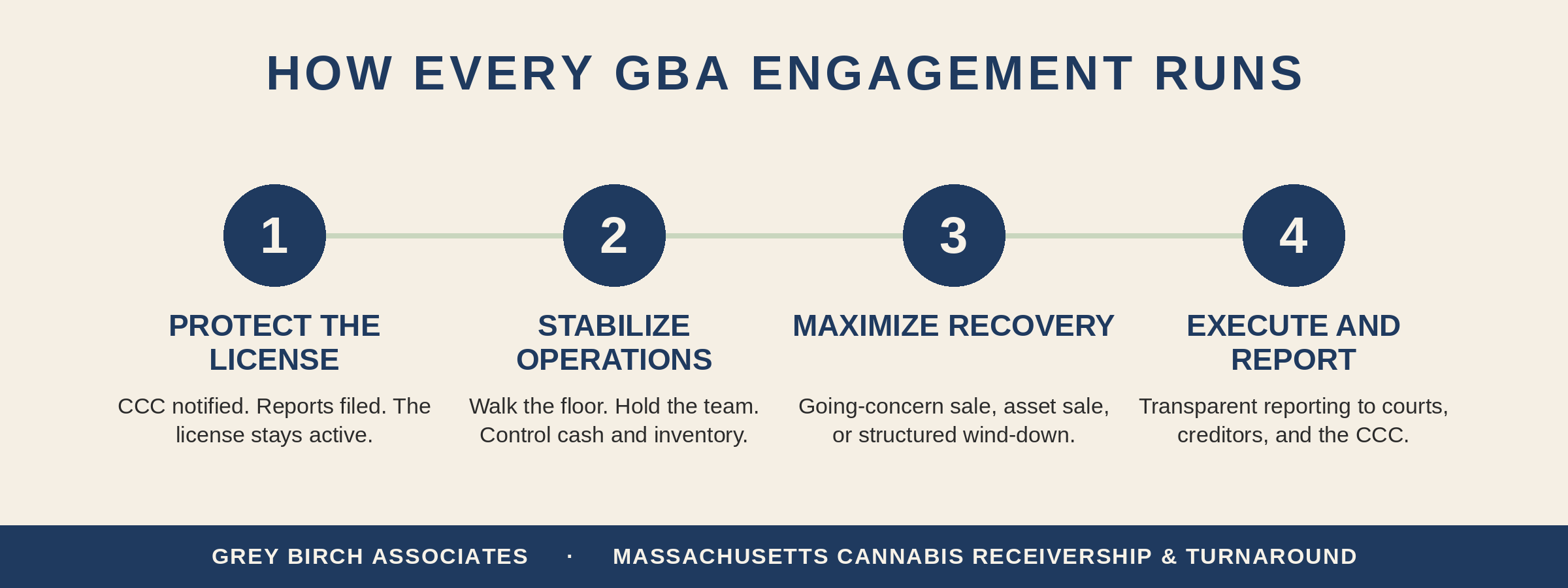
What does a receiver actually do? The six phases
Massachusetts cannabis receiverships tend to move through six phases:
Petition and appointment. The case is filed and the court appoints the receiver.
Acceptance and the first 48 hours. The receiver takes control and notifies the CCC.
Stabilization and inventory. Within 30 days of appointment, Superior Court Rule 51 requires the receiver to file a detailed inventory with the court: all property, estimated values, liens and encumbrances, and known creditors. The receiver keeps the business running and reports to the court regularly, often monthly.
Marketing and sale. The receiver, often with a specialized sale advisor, markets the business to qualified buyers.
Court and CCC approval of the sale. The court approves the sale and the CCC approves the license transfer to the buyer.
Wind-down and discharge. Remaining assets are distributed in priority order, final accounts are filed, and the court discharges the receiver.
What happens to the cannabis license?
The license is the crown jewel of the estate. Keeping it active and compliant is the receiver's central job, because a going business with a live license is worth far more than equipment and inventory sold off piece by piece. In a sale, the license is transferred to a CCC-approved buyer. If the license lapses or is revoked, most of the value disappears, which is why experienced cannabis receivers move so quickly on compliance.
Going-concern sale, asset sale, or wind-down?
There are three broad outcomes. A going-concern sale transfers the operating business as a living entity, including the license where the rules allow, and usually returns the most to creditors. An asset sale sells the pieces (equipment, inventory, real estate) individually, and typically recovers less. A wind-down is an orderly closure when no viable buyer emerges. A good receiver steers toward whichever path recovers the most value. As an illustration of the going-concern path, the first Massachusetts cannabis receivership ended in a court-approved sale of the operating business, license included, to a multistate operator.
Who gets paid, and in what order?
Massachusetts courts distribute the estate through a priority "waterfall" that closely tracks federal bankruptcy priorities. In simplified terms: perfected secured creditors are paid first from the specific collateral they hold; then the administrative costs of the receivership (the receiver's and professionals' fees, and the cost of preserving the assets); then priority claims, including federal taxes; then general unsecured creditors; and finally the equity owners, who are last and often recover nothing. Federal tax obligations receive special treatment, and a receiver must reserve for them carefully.
How long does it take, and what does it cost?
Timeline depends mostly on how the case starts. A consensual appointment can happen in days; a contested one can take months. From start to discharge, cannabis receiverships commonly run from several months to about two years, depending on how quickly a buyer is found and the sale is approved.
On cost, the receiver is generally paid an hourly fee that the court must approve, and that fee is paid from the estate as a priority administrative expense rather than out of the creditor's pocket (though in a case with no cash, the lender that sought the receiver may have to fund it). If a sale advisor is engaged, they typically earn a commission on the completed sale, usually in the low single digits as a percentage. There is also a small court deposit at the outset. Actual cost depends on the size and complexity of the business and whether it is still operating.
What makes a good cannabis receiver?
Three things matter most. First, CCC pre-approval: the Commission maintains a list of pre-approved receivers, and using one can mean a faster appointment without a separate vetting delay. Second, hands-on cannabis operating experience: a receiver who has actually run a licensed cannabis business knows how to keep it compliant, staffed, and valuable while the court process runs. Third, transparency: regular, clear reporting keeps the court, the CCC, and creditors aligned and protects the outcome.
Grey Birch Associates is a CCC pre-approved receivership and turnaround firm led by former Massachusetts cannabis operators. We protect license value and maximize creditor recovery. If you are a lender, creditor, attorney, or operator facing a distressed Massachusetts cannabis business, contact Grey Birch Associates. We move fast.
For what this looks like in practice, see our operating and transaction experience.
Facing this now?
Planning?
Developed by: Grey Birch Associates, Jeremy Bromberg, 2026Frequently Asked Questions
-
No. Because cannabis is federally illegal, cannabis companies generally cannot file federal bankruptcy. A Massachusetts receivership is a state-court process that serves a similar purpose: an orderly turnaround, sale, or wind-down under court supervision.
-
Yes. Keeping the licensed business open and compliant usually preserves the most value, so a receiver typically continues operations while a buyer is found.
-
Protecting the license is the receiver's first priority. The receiver notifies the Cannabis Control Commission, keeps the license in good standing, and, in a sale, transfers it to a CCC-approved buyer. A lapsed or revoked license can wipe out the value.
-
A neutral third party appointed by the court. The Cannabis Control Commission approves and publishes a list of pre-approved receivers, which will speed appointment.
-
It varies. When the company or its lender consents, a receiver can be appointed in days; contested cases take longer, and a full case commonly runs several months to about two years
Disclaimer. This guide is general information about Massachusetts cannabis receivership, not legal advice, and it does not create any client relationship. Outcomes depend on the specific facts, the court, and the terms of the appointment order. For advice on a particular situation, consult qualified counsel. Grey Birch Associates is a receivership and turnaround firm, not a law firm.